A fit-out or an interior renovation done in any space including commercial or retail spaces, and office buildings undergo regulation. A building permit needs to be issued in accordance with the National Building Code of the Philippines.
General contractors such as Corebilt can help facilitate the build and secure necessary documentation or permits that the build or work will require.
Phase 1 | Pre-Application & Prerequisites
Proper preparation of pertinent documents is required before a submission before the Office of the Building Official (OBO) can be done.
Depending on the type of fit-out or build, the following documents will be required:
- Locational/Zoning Clearance must come from the City/Municipal Planning & Development Office (CPDO/MPDO). This will confirm the intended commercial use is compatible with the zone.
- Property documentation evidenced through TCT/OCT, Tax Declaration, or notarized Lease Contract
- Barangay Construction Clearance should be from the barangay where the unit or space is located.
- Building Administration / PMO Approval / Permit to Renovate
Both the LGU building permit and the building administrator’s permit-to-renovate are required even if fit-outs are done inside condominiums or PEZA buildings.
- Homeowners’ Association (HOA) or Condominium Corporation endorsement (if applicable)
PHASE 2 | Core Building Permit Documents
Once all prerequisites are ready, one must submit to the OBO using the DPWH Form No. NBCP-BAF-001 (Building Permit Application Form). This should be notarized and signed by the owner or an authorized representative under a Special Power of Attorney (SPA).
There are three types of documents that will be required:
Plans & Technical Documents
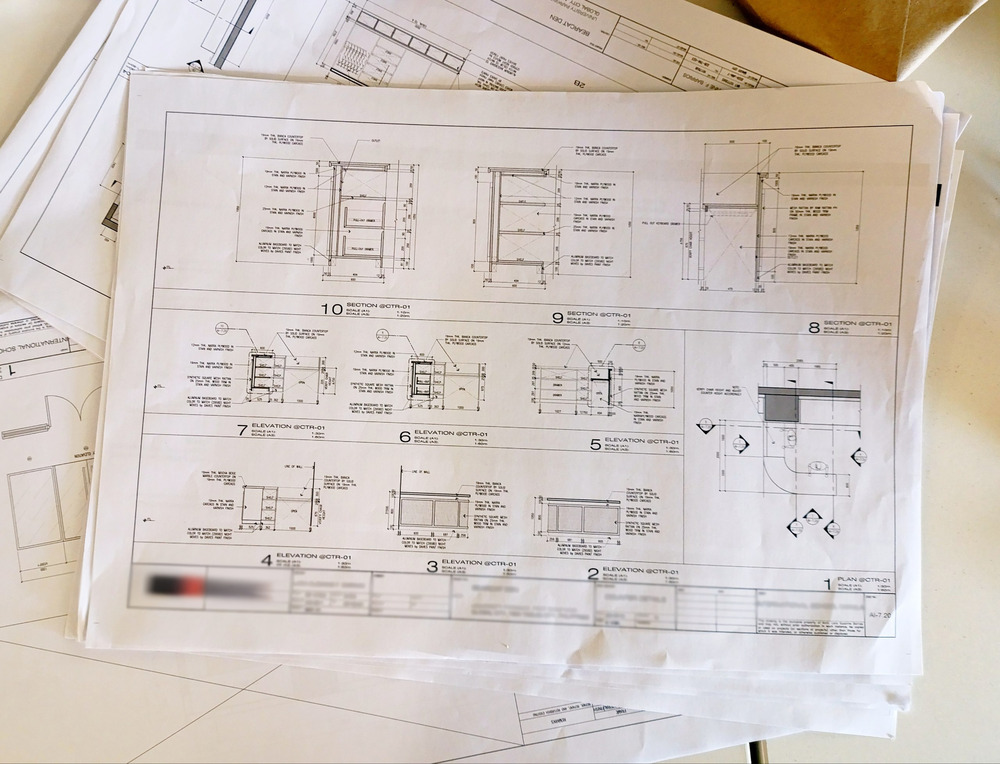
- Architectural Plans – floor plan, reflected ceiling plan, interior elevations, door & window schedule; signed and sealed by a licensed Architect (PRC + PTR current)
- Structural/Civil Plans – if adding mezzanine, heavy partition loads (>200 kg/m²), or structural modifications; signed by a licensed Civil/Structural Engineer
- Electrical Plans – load schedule, panel board layout, single-line diagram; signed by a Professional Electrical Engineer (PEE) or Master Electrician
- Mechanical Plans – HVAC/aircon system, if applicable; signed by a Professional Mechanical Engineer (PME)
- Sanitary/Plumbing Plans – if comfort rooms or drainage are relocated; signed by a Sanitary Engineer
- Electronics/Communications Plans – data, structured cabling, security systems (ECE-signed)
- Fire Protection Plans – sprinkler layout, fire alarm system, exits; signed by a Fire Protection Engineer (FPE) or Fire Safety Practitioner
Supporting Technical Documents:
- Bill of Materials and Cost Estimates (BOQ) signed by Architect/Engineer; a PCAB-licensed contractor is required if project cost exceeds ₱50,000
- Technical Specifications
- Structural Analysis/Computations (if mezzanine or heavy loads involved)
- Recent photographs of the affected area (before renovation)
- Data Sheets of all mechanical, electrical, and electronics equipment
- Occupant Load Density Certification signed by the Building Admin/Manager – required for BPO/IT offices and similar uses
Professional Credentials
All signing professionals must provide:
- Four (4) clear copies of valid PRC License and PTR (Professional Tax Receipt) of each signing professional
PHASE 3 – FIRE SAFETY & ANCILLARY REQUIREMENTS
The Fire Safety Evaluation Clearance (FSEC) must be obtained from the Bureau of Fire Protection (BFP) before (or in parallel with) the building permit application, and the Fire Safety Inspection Certificate (FSIC) is required before occupancy.
- FSEC Application Form
- Fire Protection Plans (submitted to co-located BFP personnel at OBO)
- Proof of payment of Fire Code fees
These are separate permits filed simultaneously with the main building permit:
- Electrical Permit
- Mechanical Permit (if HVAC/aircon, generators, or other mechanical works)
- Sanitary/Plumbing Permit (if toilet/drainage works)
- Electronics Permit (data, CCTV, fire alarm, access control)
There are additional requirements for PEZA-registered enterprises such as the the Letter of Application for the building permit must be addressed to the PEZA Director General for NCR, Central Luzon, Bicol, or the PEZA Zone Administrator for Cebu, Mactan, Batangas, Laguna zones.
- Copy of PEZA Certificate of Registration and Registration Agreement or Board Resolution PEZA
- Copy of Contract of Lease between lessor and lessee, or PEZA-issued Letter of Authority (LOA) to sub-lease PEZA
- LOA for expansion, site transfer, or relocation (if applicable)
PHASE 4 | DURING & POST – CONSTRUCTION
Once all documents were reviewed and approved, the following documents will be required all throughout the build:
- Posted Building Permit must be laminated, and displayed at site frontage
- Project Billboard (1.2 m x 1.0 m) must also posted at frontage
- Full-time Construction Safety & Health Officer (COSHO) will be required if workforce is 15 or more, or project cost exceeds ₱3 million
- Onsite Construction Logbook
- Waste Management/Segregation Plan in accordance with RA 9003 and LGU ordinances
- OBO inspections at three stages: rough-in/before concealment, pre-finishing, and final
After the build is complete, the following documents must be issued:
- Certificate of Completion signed by all designers and the contractor
- As-Built Plans with notarized Certificate of Completion, and commissioning/testing reports for electrical, mechanical, and electronics works
- Fire Safety Inspection Certificate (FSIC) from the Bureau of Fire Protection
- Certificate of Occupancy (C/O) must be issued within 5 days of favorable final inspection as this is prerequisite for business permits, utility meter energization, and BIR VAT zero-rating
- Business/Mayor’s Permit from the respective LGU
- Sanitary Permit (from City Health Office, especially for F&B tenants)
KEY CONSIDERATIONS FOR 2026
- Processing time
The NCP mandates all OBOs to act on a completed application within 15 days, otherwise, this will be deemed approved. Please note that some LGUs will require a physical permit release.
- Penalties
Failure to secure or comply with permitting regulations will result in stop-work orders, daily fines of P10,000 to P100,000 depending on the designated LGU. Criminal liability is also possible under the NBCP.
- E-Permits
Several LGUs such as Quezon City, Pasig City, and Cebu City now accept electronic plan submissions through their designated portals.
- Heritage Buildings Works
Additional endorsement from the National Commission for Culture and the Arts or the LGU heritage councils will be required.
Requirements vary by LGU or the type of builds. This is why it is wise to work with an end-to-end, professional and expert general contractor who will assist in verifying the specific checklist with your local Office of the Building Official (OBO), Property Management Office, or the BFP before filing.
Contact us today at bd@corebilt.ph to get started.