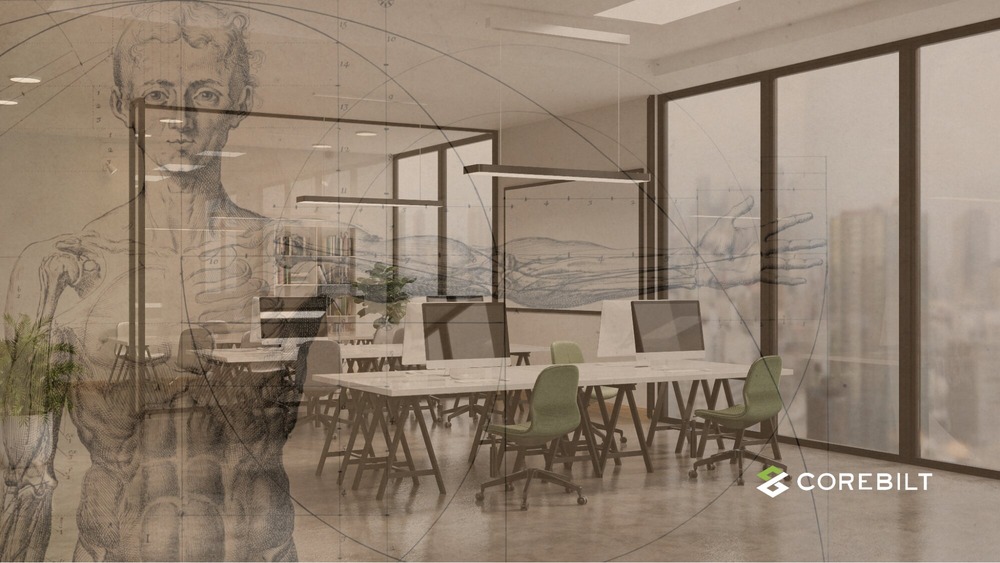
Modern workspace ergonomics traces its formal foundations to mid-20th century industrial research conducted primarily in Europe and North America. The benchmark figures that shaped everything from desk heights to aisle clearances to overhead reach zones were drawn from studies of military personnel, factory workers, and office employees, populations that were predominantly male, predominantly Caucasian, and considerably larger in average stature than most of Southeast Asia.
What is Anthropometrics?
Anthropometrics is the scientific study of human body measurements including height, limb length, shoulder width, sitting height, reach, and dozens of other physical dimensions that vary across individuals and populations.
In workplace design, it serves as the foundation for determining how furniture, equipment, and space should be sized and arranged so that people can work comfortably, safely, and without unnecessary physical strain.
The core principle is straightforward: a workspace should fit the person using it, not the other way around. Where anthropometrics goes wrong is when the measurements used to define “the person” are drawn from a population that bears little physical resemblance to the people actually sitting at the desks.
Filipino Anthropometrics vs. Global Standards
Based on ISO and BIFMA standards, a “standard” desk height of 720-750mm. A “neutral” monitor distance of 50-70cm. Seat pan depths calibrated for a 50th-percentile American male. These are not neutral measurements.
Filipino men average approximately 163cm in height; Filipino women, around 152cm. The 50th-percentile American male used as a baseline in most international ergonomic tables stands at roughly 176cm. That 13-centimeter gap, amplified by differences in trunk-to-leg proportion and sitting height, compounds across every dimension of a workstation: elbow height, eye level, reach envelope, knee clearance, lumbar support positioning.
What the mismatch produces in practice
When a Filipino worker sits at a standard 720mm desk, their elbow is typically below the work surface rather than level with it. To compensate, they raise their shoulders, crane their neck forward, or perch on the front edge of the seat to gain height, each posture a slow accumulation of muscular fatigue. Over the course of an eight-hour day, these micro-adaptations become the ordinary background noise of discomfort that workers rarely name as a design failure because they have never worked in anything different.
Chair seat pan depth is another silent battle. A seat pan designed for a 50th-percentile Western male, typically 420-450mm deep, forces a shorter worker to either press the back of their knees against the edge, cutting off circulation, or slide forward until the lumbar support no longer reaches them. Both are common. Neither is visible in a workplace audit that only checks whether adjustable chairs are present.
It’s not just personal
The anthropometric problem doesn’t stop at the furniture. Space planning itself, the allocation of circulation widths, the depth of workstation bays, the height of storage walls, the reach distance of overhead systems, carries the same hidden Western calibration.
Overhead storage systems, kitchen countertops, and whiteboard mounting positions are routinely set to eye-level and reach distances that simply don’t correspond to the Filipino worker’s dimensions.
What locally calibrated design actually looks like
Correcting for Filipino anthropometrics is not a radical redesign, it is a recalibration of parameters that are already adjustable. Desk heights in the 680-700mm range rather than 720-750mm. Chair seat pans in the 380-400mm depth range.
Monitor arms set to shorter reach defaults. Overhead storage positioned at locally relevant reach maxima. Circulation and collaboration clearances revalidated against local body dimensions rather than inherited from foreign references.
The more significant shift is procedural. It requires treating local anthropometric data as a primary design input and not just an afterthought applied when a worker complains and specifying furniture with the adjustment range needed to serve the full distribution of Philippine worker dimensions, not just those who happen to fall near a Western median.
Bodies that are comfortable at work focus better, produce more, and go home without the accumulated strain of a space that was quietly built for someone else.
Corebilt Joineries & Custom Furniture
Corebilt designs workplace environments calibrated to the people who actually work in them. With an in-house joineries team, we make sure that every space–and all its parts are customized for the actual occupants of the space.
Want to build a space that doesn’t only reflect your brand but serves your team best? Collaborate with us today and let’s discuss your next project! Send an email to bd@corebilt.ph for a consultation!